
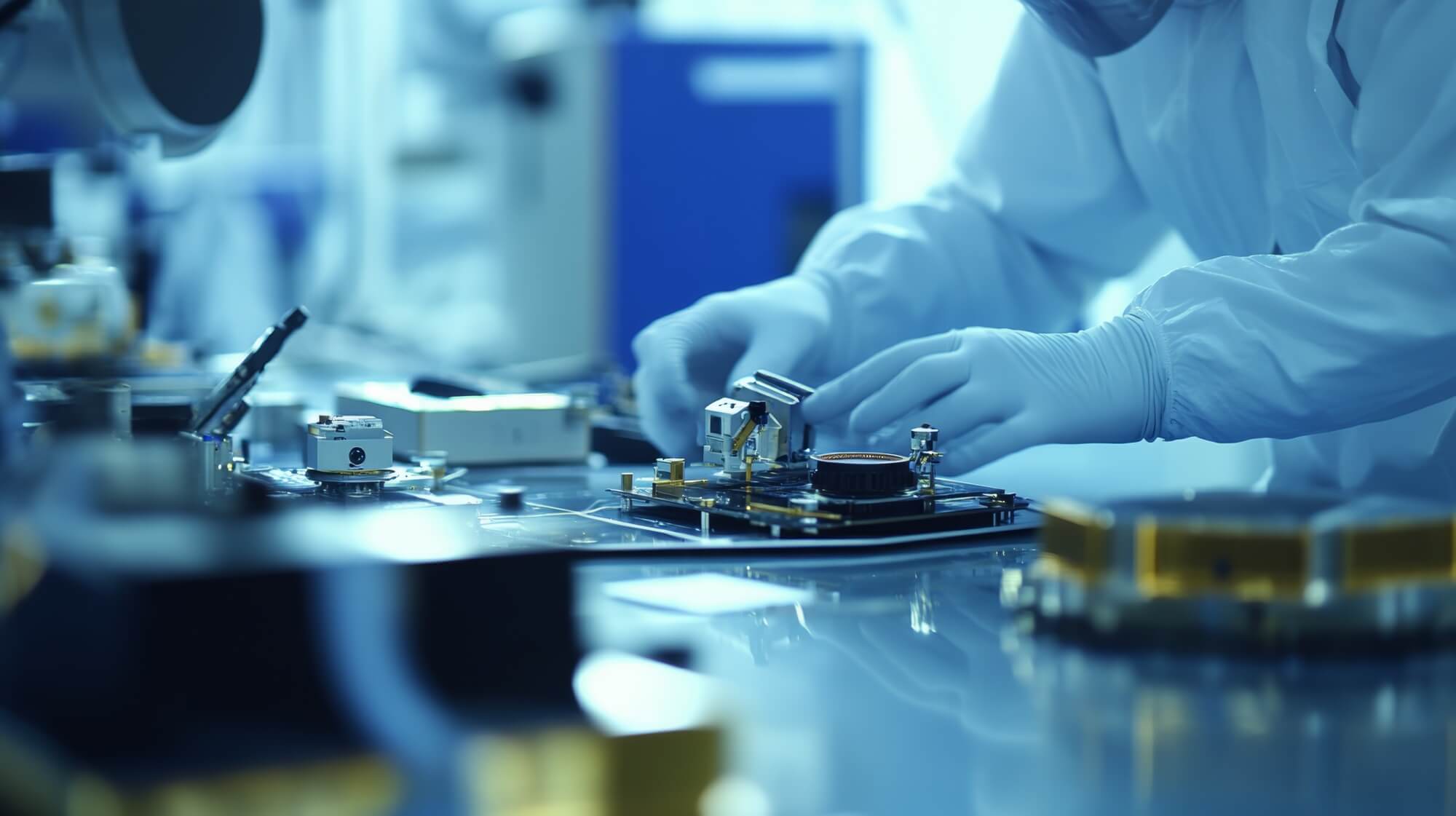
In industries like aerospace, cleanrooms are crucial for manufacturing, providing a controlled environment with ultra-low levels of airborne particles. Cleanrooms help ensure that manufactured parts meet industry standards, because even the smallest contaminants can cause catastrophic failures.
For companies building flight-critical hardware, cleanliness is directly tied to safety, performance, and compliance. That’s why working with a CNC partner that can machine, clean, assemble, and verify parts under one roof makes such a difference.
At Ben Machine, high-precision machining is supported by our in-house ISO Class 7 cleanroom, designed for sensitive aerospace and defence work. This integrated aerospace cleanroom service allows components to move from production to controlled cleaning and assembly without unnecessary handling, reducing risk while protecting schedules.
When tolerances are tight and reliability is non-negotiable, environment matters just as much as equipment.
What Is an Aerospace Cleanroom?
An aerospace cleanroom is a specially engineered space where airborne particles, temperature, humidity, and electrostatic risks are tightly controlled. These rooms are classified by the maximum number of particles permitted per cubic metre of air.
ISO Class 7, for example, allows no more than 352,000 particles at 0.5 microns. For context, that is dramatically cleaner than a typical manufacturing floor. Meeting this classification means parts are far less likely to be exposed to debris that could affect fit, finish, or function.
Some processes may also reference ISO Class 8 levels, which allow a higher particle count. Understanding which class applies depends on the component’s sensitivity, its regulatory requirements, and how it will be used in the field.
To achieve these targets, cleanrooms are designed to rely on a combination of systems:
- HEPA filtration to capture microscopic contaminants
- Positive air pressure to keep unfiltered air out
- Temperature and humidity control for material stability
- ESD protection for electronics and assemblies
Our cleanroom technology includes advanced purification processes, such as reverse osmosis (RO) water purification, ultrafiltration, deionization, and UV sterilization. We also employ high-purity aqueous and non-aqueous cleaning solutions to remove films, oils, greases, and cutting fluids from parts.
You can see a deeper overview of how our aerospace cleanroom service supports production on our cleanroom capabilities page.
The Role of Aerospace Cleanrooms in Modern Manufacturing
The aerospace industry relies on cleanroom environments for producing a wide range of components, including electronic systems, propulsion parts, and sensors that require ultra-high cleanliness standards. In these environments, factors such as particle count, temperature, humidity, and airflow are precisely controlled to ensure parts meet exact specifications. At Ben Machine, we adhere to ISO-compliant cleanroom standards, meeting Level 7 cleanliness requirements.
But a cleanroom doesn’t stand apart from CNC machining—it works alongside it.
Modern aerospace programs demand:
- Tighter geometric tolerances
- Improved surface finishes
- Repeatable assembly performance
- Documented traceability
Even minor contamination can affect bonding surfaces, clog micro-passages, or interfere with optical and electronic systems. By transitioning parts directly from machining into controlled cleaning and assembly, manufacturers significantly reduce those risks.
A clean environment also helps preserve the quality already built into the component. Burr removal, precision washing, packaging, and sub-assembly can all occur without reintroducing debris from an open shop floor.
This is particularly important for:
- Flight sensors
- Guidance and communication electronics
- Hydraulic and propulsion components
With turnkey support for mechanical, optical, and electro-mechanical assemblies, an integrated CNC machine shop with aerospace cleanroom assembly capabilities helps programs move faster while maintaining compliance.
Beyond cleanliness, controlled environments also support process validation. When airflow, humidity, and particle levels remain stable, it becomes easier to maintain repeatability from batch to batch. Inspection data is more consistent, root-cause analysis becomes clearer, and qualification efforts move faster.
Key Components of an Aerospace Cleanroom
Behind every certified cleanroom is a network of systems working together to protect part integrity. Understanding these elements helps clarify why controlled assembly leads to better outcomes.
HEPA Filtration
High-efficiency filters continuously scrub the air, removing microscopic particles before they can settle on parts.
Positive Pressure
Air is pushed outward whenever doors open, preventing unfiltered air from entering the workspace.
Temperature & Humidity Controls
Stable conditions prevent corrosion, oxidation, and dimensional changes, which are essential for precision assemblies.
ESD Safeguards
Our facility is fully optimized to support ESDS assembly and ESD safe operations, combining best-in-class safety practices with industry-compliant infrastructure. Grounded stations, protective flooring, and operator protocols protect sensitive electronics.
Environmental Monitoring
Real-time systems track particle levels, airflow, and pressure differentials so any deviation is addressed immediately.
In practice, this can mean dozens of HEPA-filtered air exchanges per hour and validated work areas designed specifically for aerospace hardware.
Standards and Compliance in Aerospace Cleanrooms
CNC aerospace machine shops must comply with rigorous ISO standards such as AS9100:D and ISO 9001:2015. By adhering to these standards and integrating cleanroom practices, Ben Machine ensures the highest level of quality and safety in aerospace manufacturing.
So what do these certifications involve?
- AS9100:D adds aerospace-specific requirements to quality management, including risk mitigation, configuration control, and traceability.
- ISO 9001:2015 focuses on consistent processes, documentation, and continuous improvement.
- ISO 14644 governs cleanroom classification and verification.
Regular audits confirm that procedures, training, and environmental controls are functioning as intended. For customers, this translates into confidence: fewer surprises, lower failure risk, and smoother qualification processes.
Ensuring Component Integrity
Strict adherence to these standards enhances Ben Machine’s high precision manufacturing capabilities. By minimizing contamination during machining, we improve the reliability and consistency of the manufacturing process. Our cleanroom capabilities ensure that parts are free of contamination, which is essential for maintaining the integrity of aerospace components and meeting exacting industry requirements.
The benefits are measurable. Cleaner environments help:
- Maintain critical surface finishes
- Protect tight mating tolerances
- Reduce premature wear
- Extend service life
Another advantage is packaging and handling. Once parts are cleaned and verified, they can be sealed, labelled, and shipped directly from the cleanroom. This protects components during transport and helps ensure they arrive ready for installation or further integration.
It’s a small detail, but one that can prevent costly issues once hardware reaches the next stage of the supply chain.
Because machining and cleanroom teams operate within the same workflow, parts move efficiently from production to wash, inspection, and assembly. There’s less handling, clearer accountability, and faster turnaround.
For high-mix, low-volume aerospace programs, that continuity can be just as valuable as the machining itself.
When Should You Specify Cleanroom Manufacturing?
Not every aerospace component demands cleanroom processing, but many benefit from it more than teams initially expect. As assemblies become smaller, more complex, and more electronically integrated, sensitivity to contamination continues to rise.
Cleanroom manufacturing is often recommended when parts involve:
- Precision fluid or air passages
- Optical surfaces
- Bonding or sealing interfaces
- Sensitive electronic systems
If there is uncertainty, early collaboration between design, quality, and manufacturing can determine the right level of environmental control. Making that decision sooner prevents redesigns and last-minute production changes later.
FAQs
How does an ISO Class 7 cleanroom improve the quality of aerospace parts?
By limiting airborne particles and stabilizing environmental conditions, ISO Class 7 spaces reduce contamination that could interfere with fit or function. When tied directly to CNC production, components remain protected from the moment machining is complete through cleaning and assembly, improving reliability and supporting compliance.
Can a CNC machine shop with an aerospace cleanroom handle both prototyping and full-scale production?
It depends on the shop, but those that can take on full-scale production can also generally handle prototyping. The same contamination controls that protect production hardware also benefit prototypes. Teams can iterate quickly, validate designs, and then scale volumes without changing environments or suppliers.
What makes Ben Machine’s aerospace cleanroom service different from standard cleanroom offerings?
It’s the integration. Machining, finishing, cleaning, assembly, and verification occur within one coordinated system. By adding ISO Class 7 certification, ESD-safe operations, and continuous monitoring, customers gain a streamlined path from raw materials to ready-to-install hardware.
How does a cleanroom environment affect the assembly and testing of aerospace components?
Cleaner assemblies mean more accurate testing and fewer variables. Sensors read properly, moving parts operate smoothly, and documentation reflects true performance rather than contamination issues.
Are cleanroom services necessary for all CNC aerospace manufacturing projects?
Not always. However, mission-critical, high-precision, or regulated components benefit significantly. When failure isn’t an option, extra control is usually worth the investment.
Work with a Manufacturing Partner Committed to Quality and Compliance
When you partner with Ben Machine, you gain a trusted ally committed to precision, quality, and regulatory compliance. We ensure excellence in every component we manufacture, backed by industry-leading standards that meet all necessary aerospace requirements. Our dedication to quality and safety guarantees superior performance, allowing you to focus on innovation and success in the aerospace sector and beyond.
If you’re evaluating suppliers, exploring new programs, or need added contamination control, our team is ready to help. Learn more about our cleanroom solutions or reach out for a consultation and quote to see how integrated machining and controlled assembly can support your next project.
