

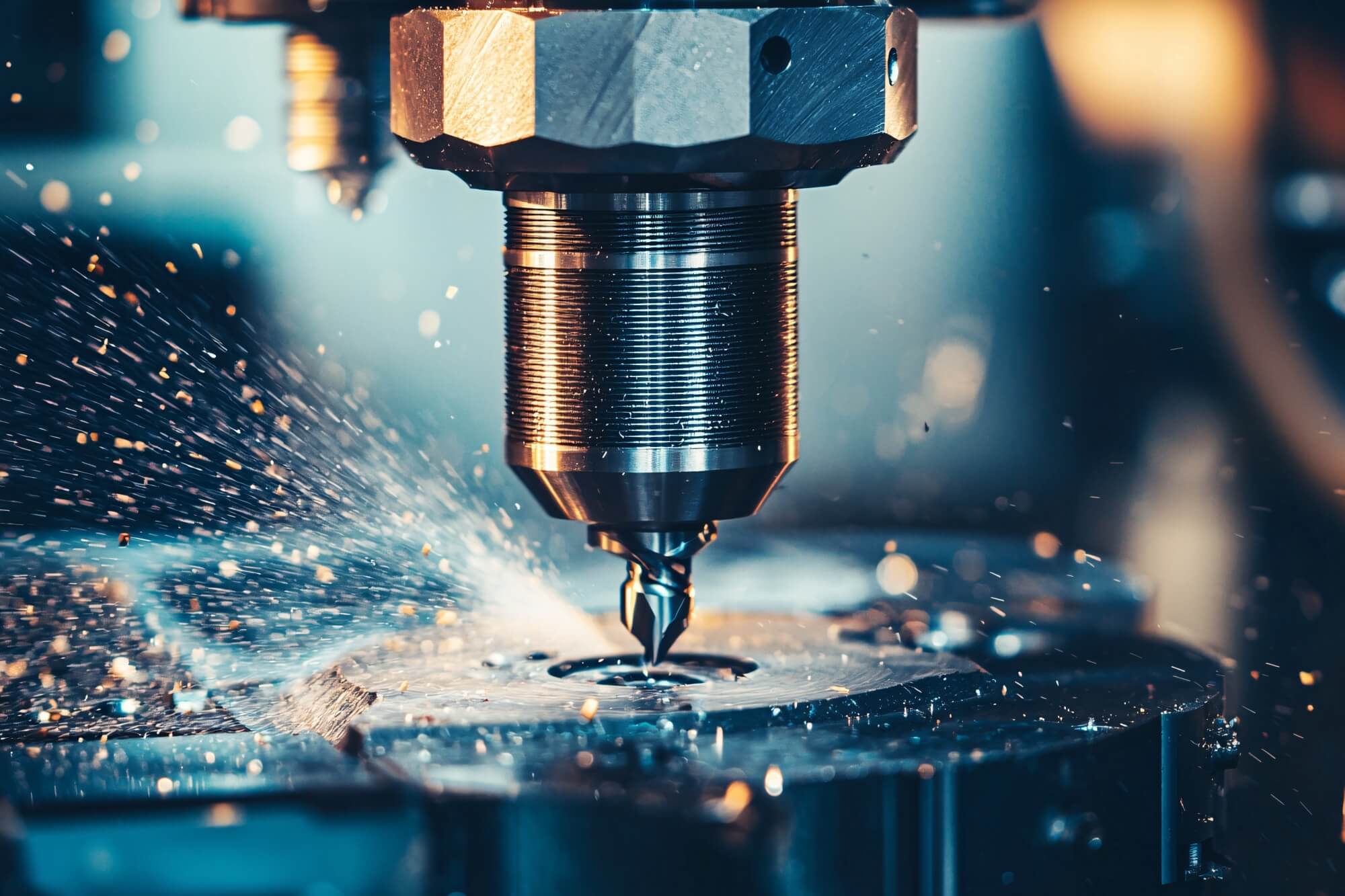
High-speed CNC spindles have had a meaningful impact on modern CNC milling, helping manufacturers meet growing demands for speed, precision, and consistency. As production requirements increase and part designs become more complex, spindle performance plays a much larger role in overall machining efficiency than it once did. Milling at higher cutting speeds allows for faster feed rates, improved surface finishes, and reduced cycle times — all of which contribute to better productivity and cost control.
In today’s manufacturing environment, tighter tolerances and shorter lead times are no longer limited to high-volume production. Industries such as aerospace, medical, and advanced electronics — many of which operate in high-mix, low-volume settings — now expect fast turnaround without compromising quality. In these scenarios, the spindle isn’t just another machine component; it’s a central part of the machining ecosystem that directly affects throughput, tool performance, and part accuracy.
This article explores how high-speed spindles can operate at elevated RPMs and what that means in real-world machining applications, including:
- How high-speed spindles operate at elevated RPMs in practical machining applications
- The key performance benefits, such as reduced cycle times, improved surface finishes, and increased efficiency across a wide range of materials
- Environmental, energy, and safety considerations associated with high-speed machining
- The role of high-speed spindles in supporting competitive, high-mix, low-volume manufacturing.
For both buyers evaluating CNC capabilities and design engineers looking to push part performance further, understanding the role of high-speed spindles can help inform better decisions upstream — where they matter most.
What Are High-Speed Spindles?
A high-speed machine tool spindle is an advanced CNC component designed to operate at significantly higher rotational speeds than traditional spindles. While conventional spindles often run below 10,000 RPM, high-speed spindles typically operate in the range of 10,000 to 60,000 RPM or higher, depending on the application and machine design.
These higher speed ranges matter because cutting speed is directly tied to tool diameter and material type. For smaller cutting tools — standard in precision milling, aerospace components, and fine-feature work — higher RPM is required to maintain optimal surface footage. Without sufficient spindle speed, tools will run inefficiently, increasing wear, reducing surface quality, and extending cycle times.
High-speed CNC spindles differ from traditional spindles in several important ways:
- Much higher operating RPMs, enabling faster cutting and feed rates
- Integral motor designs, where the motor is built directly into the spindle housing
- Advanced bearing systems, engineered to handle extreme rotational speeds
- Thermal compensation systems, designed to maintain accuracy during prolonged high-speed machining
Thermal management is critical at elevated speeds. As spindle RPM increases, so does heat generation. Without proper thermal compensation, even small temperature changes can lead to spindle growth and positional drift. Modern high-speed spindles use a combination of cooling systems, sensors, and control algorithms to maintain dimensional accuracy — something design engineers rely on when tolerances are tight.
Integral motor spindles also reduce vibration by eliminating belts and mechanical drive components. This improved balance and stiffness help extend tool life, improve surface finish, and maintain accuracy at speed. Combined with proper spindle rigidity, these design features allow high-speed spindles to machine complex geometries reliably.
High-speed spindles are commonly used to produce components such as aerospace brackets, mould and die features, electronics housings, and precision medical parts — applications where speed, accuracy, and finish quality are all critical.
Core Benefits of High-Speed Spindles
Higher spindle speeds offer several significant benefits in CNC machining, particularly in terms of efficiency, precision, and flexibility. While speed is often the most obvious advantage, the actual value of high-speed spindles becomes clear when looking at how they affect the entire machining process.
Reduced Cycle Times and Faster Tool Paths
One of the most direct benefits of high-speed spindles is reduced cycle time. Higher RPM allows tools to run at higher feed rates while maintaining proper chip load. This means material can be removed more quickly without sacrificing tool life or surface quality.
At higher speeds, tools engage the material more consistently, enabling smoother toolpaths and smaller stepovers. This benefit is especially valuable in finishing operations, where fine tool engagement reduces cutting forces and allows the machine to maintain speed through complex geometries.
In industries like aerospace and medical manufacturing, where parts often involve intricate features and long toolpaths, even small reductions in cycle time can have a noticeable impact. Shorter machine runtimes translate directly into lower per-part costs, improved scheduling flexibility, and increased overall throughput — all without adding more machines to the floor.
Ideal for High-Mix, Low-Volume Manufacturing
High-mix, low-volume (HMLV) production presents unique challenges. Frequent changeovers, custom tooling, and varying part geometries can quickly create bottlenecks, especially when machining time exceeds expectations.
High-speed spindles help offset these challenges by reducing the time required to cut each part. Faster toolpaths mean that even complex or low-quantity components can be machined efficiently, allowing shops to move through diverse job schedules without one long-running program tying up a machine.
For decision-makers, this translates into shorter lead times, better delivery performance, and improved responsiveness to customer needs. For design engineers, it means more freedom to specify fine features or tighter tolerances without significantly increasing machining time.
In HMLV environments, spindle speed becomes a competitive advantage — helping shops balance flexibility with efficiency while maintaining consistent quality across varied workloads.
Superior Surface Finishes
Another significant benefit of high-speed spindle systems is the quality of surface finishes they can achieve. Higher RPM, combined with fine stepovers and stable tool engagement, allows cutters to leave exceptionally smooth surfaces, often described as near-mirror-like finishes.
This is particularly beneficial when machining materials such as aluminum and copper, where surface quality is critical for both performance and appearance. Improved finishes reduce or eliminate secondary operations such as polishing or manual deburring, saving time and labour.
Consistent surface quality also improves part-to-part repeatability, making it easier to meet customer specifications and reduce inspection issues. Over time, these efficiencies add up — improving throughput while lowering overall production costs.
Not Just for Soft Materials
While high-speed spindles are commonly associated with aluminum machining, they are by no means limited to softer materials. With the right tooling strategies, high-speed spindles are highly effective when machining harder materials such as titanium, Inconel, and hardened steels.
Advanced tool coatings, adaptive toolpaths, and controlled coolant or air-blast strategies help manage heat and cutting forces at higher speeds. By maintaining consistent engagement and avoiding sudden load changes, high-speed spindles can machine difficult materials efficiently while preserving tool life.
This versatility is especially valuable in industries such as aerospace, where a single part may incorporate multiple materials or require both roughing and fine finishing operations on the same machine.
Environmental, Energy, and Safety Considerations of High-Speed Spindles
High-speed spindles generate more heat than conventional spindles, which increases the need for effective cooling strategies. To maintain stable machining conditions, high-speed operations often rely on higher coolant volumes delivered precisely to the cutting zone.
This increased coolant usage makes filtration and recycling systems essential. Modern CNC facilities use advanced filtration to remove fine particulates from coolant, extending fluid life and maintaining consistent performance. Proper coolant management not only protects the spindle and tooling but also reduces waste over time.
High-speed machining also increases the importance of mist extraction and ventilation. Fine coolant mist and airborne particles can pose health risks if not adequately controlled. Enclosed machining centres, combined with mist collectors and HEPA filtration systems, help maintain clean air and a safer work environment for operators.
From an energy standpoint, high-speed spindles do consume more power to maintain elevated RPMs. However, this increased consumption is often offset by shorter cycle times, reduced scrap rates, and improved accuracy. When parts are produced faster and with fewer defects, the overall energy cost per part decreases.
Achieving a positive environmental impact depends on how efficiently high-speed spindles are integrated into machining operations. When paired with innovative programming, proper tooling, and robust support systems, they can support both productivity and responsible manufacturing practices.
How High-Speed Spindles Influence Programming and Process Planning
Beyond the physical hardware, high-speed spindles also change how parts are programmed and planned on the shop floor. CAM strategies that fully leverage higher RPMs enable machinists and engineers to achieve smoother tool engagement, optimized acceleration, and more consistent cutting forces, resulting in toolpaths that are not only faster but also more predictable.
For design engineers, this opens the door to features that may have been challenging with lower spindle speeds, such as finer internal radii, smaller corner details, or thin-wall geometries. High-speed spindles make it easier to maintain stability when using small-diameter tools, which is often critical in precision components.
From a production standpoint, predictable tool behaviour simplifies process validation and repeatability. Programs developed for high-speed spindles tend to be more stable across multiple runs, reducing the need for constant adjustments. This is especially valuable in high-mix, low-volume environments where parts may be revisited weeks or months later.
For buyers and operations managers, improved process consistency means fewer disruptions, more reliable schedules, and better use of machine capacity. When programming, tooling, and spindle capability are aligned, high-speed machining becomes a dependable part of faster production rather than a niche capability.
Industry Use Cases and Impact of High-Speed Spindles
High-speed spindles have significantly influenced the CNC machining industry by enabling manufacturers to produce higher-quality parts more quickly and consistently. Their impact is especially noticeable in industries where precision cutting and flexibility are critical.
In aerospace manufacturing, high-speed spindles support high-mix, low-volume production by reducing machining time on complex brackets, housings, and structural components. Faster cycle times lead to meaningful cost savings while maintaining the tight tolerances aerospace customers expect.
In defence manufacturing, high-speed spindles support the production of precision components used in mission-critical systems, where reliability and repeatability are essential. Defence programs often involve complex geometries, tight tolerances, and lower production volumes, making efficient machining strategies critical.
In medical device manufacturing, small-diameter tools and intricate geometries are standard. High-speed spindles allow these tools to run at optimal cutting speeds, improving surface quality and reducing the risk of tool breakage. This is especially important when machining implants or surgical instruments, where precision is non-negotiable.
For electronics and mould-making, fine finishes are essential. High-speed spindles enable smooth surfaces directly off the machine, minimizing polishing and hand-finishing while shortening production timelines and improving consistency across parts.
From a business perspective, high-speed spindles also improve quoting accuracy and lead-time reliability. When cycle times are shorter and more predictable, shops can quote more confidently and remain competitive in fast-moving markets. For buyers, this means fewer surprises. For engineers, it means designs that move smoothly from concept to production.
Conclusion
High-speed spindles have become a foundational element of modern CNC milling, enabling manufacturers to balance speed, precision, and consistency in increasingly demanding production environments. Rather than serving as a niche capability, elevated spindle speeds now play a central role in how efficiently complex parts are machined and how reliably processes perform over time.
When paired with the right tooling, programming strategies, and support systems, high-speed spindles allow shops to reduce lead times, improve predictability, and respond more effectively to high-mix, low-volume demands. They also give engineers greater freedom to push part designs without introducing unnecessary manufacturing risk.
As machining requirements continue to evolve across aerospace, defence, medical, and advanced manufacturing sectors, high-speed spindle technology represents a practical investment in long-term capability. For manufacturers focused on precision, responsiveness, and process stability, it remains a key driver of competitive CNC performance.
