

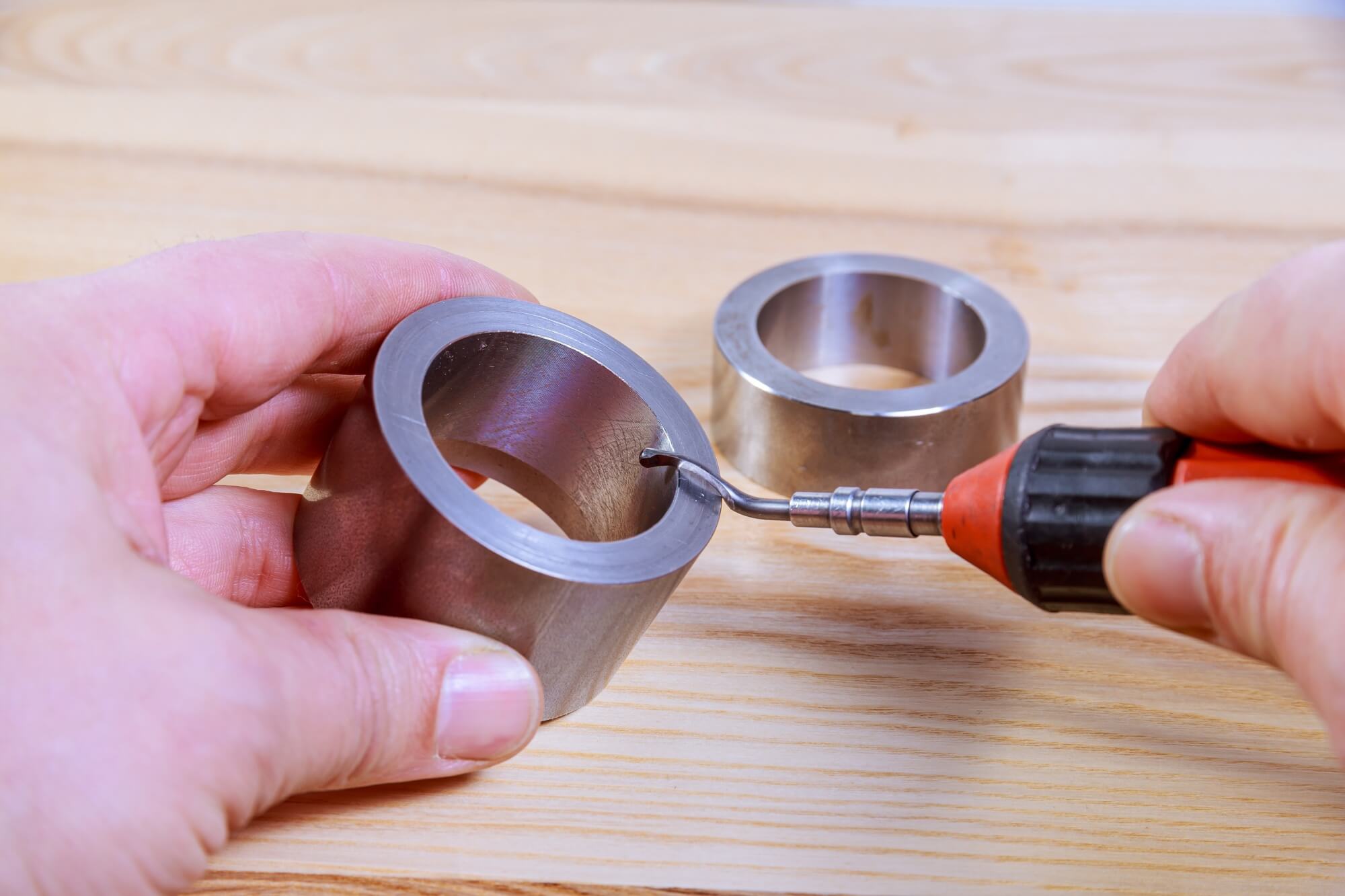
Many people may believe CNC high-precision machining is only about cutting raw materials into specific shapes. However, CNC machining encompasses many processes, and precision finishing is among the most critical. In fact, CNC finishing processes are often where a part either becomes production-ready or a costly piece of scrap.
Precision CNC finishing processes, such as grinding and polishing, are crucial for meeting exact specifications and achieving superior surface finishes in high-precision industries like aerospace, defence, medical devices, and nuclear manufacturing. These processes ensure that parts meet the correct dimensional tolerances and strict quality and performance standards.
Finishing isn’t just about appearance. It’s also about risk reduction, compliance, and real-world performance. A part can be machined to the correct dimensions and still fail if burrs damage a seal, a rough surface accelerates wear, or a coating doesn’t adhere properly. In high-demand industries, finishing errors aren’t just inconvenient; they can pose safety risks, cause reliability issues, and lead to significant delays.
In high-mix, low-volume machining, finishing matters even more because parts aren’t produced in large batches. Every job has its own material, geometry, and functional requirements. That means the finishing plan has to be intentional, controlled, and verified—especially when the part is for a critical system with a margin for error of essentially zero.
What Are CNC Finishing Processes?
Finishing processes in CNC machining are the steps taken to refine and perfect machined parts after the initial machining operations. These steps bring a component to its final condition—whether that means meeting a surface roughness requirement, removing burrs, improving corrosion resistance, or preparing the part for assembly or coating.
In a typical CNC workflow, finishing operations occur after milling, turning, drilling, or grinding. Depending on the part, finishing might include:
- Deburring and edge breaking
- Polishing or smoothing surfaces
- Bead blasting for consistent texture
- Coating or surface treatments for protection and performance
- Cleaning and inspection to ensure the part is free of debris
It’s also helpful to think about finishing in two categories:
Functional Finishing vs. Cosmetic Finishing
Functional finishing impacts how the part performs and includes anything that affects fit, sealing, fatigue resistance, wear, friction, or corrosion protection.
Cosmetic finishing focuses more on appearance, branding, or uniformity—like a consistent matte texture or a clean, polished look.
In fact, many finishing steps do both. A smoother surface might look better, but it can also reduce friction, improve sealing, and increase fatigue life.
At a technical level, finishing directly affects:
- Tolerances: burrs and rough edges can throw off fits and assemblies
- Fatigue life: micro-defects and sharp edges can become crack starters
- Corrosion resistance: surface condition impacts how well coatings perform
- Assembly performance: parts that “should fit” often don’t without proper finishing
Core CNC Finishing Techniques Explained
CNC finishing isn’t one single step—it’s a set of processes that help bring a machined part to its final, usable condition. The proper finishing method depends on the material, the geometry, the tolerance requirements, and the part’s application. For critical industries like aerospace and defence, surface finishing isn’t optional—it’s a key part of performance and reliability.
|
Process |
Purpose |
Key Benefits |
Typical Use Cases |
|
Deburring |
Remove burrs & sharp edges |
Improves fit, reduces contamination |
Aerospace, defence, precision assemblies |
|
Polishing |
Smooth surface & reduce tool marks |
Enhances fatigue resistance & sealing |
High-stress parts |
|
Bead Blasting |
Uniform texture & surface prep |
Prepares parts for coatings, hides machining marks |
Metal parts, coatings |
|
Coating |
Corrosion/wear resistance |
Extends part life, aesthetic finish |
Defence-grade & aerospace components |
Deburring
Deburring involves removing burrs, small bits of material that remain attached to a part after it is machined. Burrs commonly appear around drilled holes, milled edges, slots, and intersecting features. Even small burrs can cause significant issues, including poor fit during assembly, damaged seals, and loose debris that creates contamination risk.
Deburring can be done manually, automatically, or through a hybrid approach:
- Manual deburring is best for complex parts, tight internal features, and edge control where precision matters.
- Automated deburring improves consistency on repeatable geometries and reduces variability when multiple parts require the same finish.
Material choice also affects deburring strategy. Aluminium can smear or form “gummy” burrs, while steel often produces tougher burrs that require more controlled removal. Deburring needs to be handled carefully because sharp edges, loose debris, or inconsistent edge breaks can lead to assembly problems and long-term reliability concerns.
Polishing
Polishing removes visible tool marks and creates a smooth, often shiny surface on a part, which can be important for both aesthetic and functional reasons. While some polishing improves appearance, many specifications are functional and tied to how the part performs under load, friction, or repeated use.
Polishing can support performance by improving:
- Sealing surfaces: reducing leak risk
- Wear surfaces: reducing friction and premature wear
- Fatigue resistance: reducing stress risers from tool marks or sharp transitions
Polishing eliminates surface roughness (measured as Ra). The smoother and more controlled the surface finish, the more predictable the part’s performance becomes—especially in high-stress or high-vibration environments like aerospace and defence systems.
Bead Blasting
Bead blasting improves CNC surface finish by propelling tiny glass beads at high speed onto a workpiece using compressed air or a mechanical system. The goal isn’t to remove a large amount of material, but to create a consistent texture and clean up minor surface imperfections.
Bead blasting can also:
- Reduce the appearance of machining marks
- Create a uniform matte finish
- Improve consistency across complex shapes
- Prep surfaces before coatings or treatments
It’s beneficial when you need a clean, uniform finish without the time and labour involved in complete polishing. That said, it is essential to carefully control the process to avoid impacting critical dimensions or functional surfaces.
Coating & Surface Treatments
Coating techniques, such as anodizing, powder coating, and plating, involve applying a coating to a part’s surface. Coatings can provide enhanced corrosion and wear resistance, as well as aesthetic improvements. In many cases, coatings are a functional requirement—especially when parts will be exposed to moisture, chemicals, friction, or outdoor conditions.
For defence and aerospace applications, coatings often come with additional requirements such as repeatability, documentation, and traceability. Many CNC shops also coordinate with approved finishing partners for specialized coatings. The key is ensuring the part is prepped correctly, protected, and inspected so the final result meets both performance requirements and quality standards.
Why CNC Finishing Processes Are Skilled Work — Not “Cleanup”
A common misunderstanding is that deburring and polishing are non-skilled labour tasks. However, these finishing processes require a deep understanding of material properties, precision techniques, and attention to detail. Mistakes at this stage can be incredibly costly, rendering a high-value part unusable and leading to significant financial and operational setbacks.
Finishing requires objective judgement, mainly when parts include:
- Tight tolerances
- Thin walls
- Precision bores
- Sealing surfaces
- Sharp internal corners
- Critical edges that must be broken “just enough”
A finisher must remove burrs without altering the geometry. They need to smooth surfaces without rounding edges that affect fit. And they need to do it consistently across parts that might only run in small batches.
The cost of finishing errors in high-value parts
Finishing errors don’t just create rework—they can wipe out the value of the entire part. For buyers, that can mean:
- Delayed delivery dates
- Unexpected cost increases
- Quality escapes into assembly
- Added inspection burden
- Damaged supplier trust
Why buyers should ask about finishing expertise
If you’re qualifying a CNC shop, finishing capability is something you should ask about directly, especially for defence, aerospace, and medical work. The best shops don’t treat finishing like an afterthought—they treat it like a controlled process that protects the value of everything that came before it.
Foreign Object Debris (FOD): A Hidden Risk in Precision Manufacturing
Foreign object debris (FOD) is a critical concern in industries that demand high precision. FOD refers to any unwanted material or object that can cause damage to machinery, equipment, or products. In aerospace, FOD can pose severe risks, including equipment failure, compromised safety, and catastrophic outcomes.
As a leader in precision manufacturing, Ben Machine places significant emphasis on avoiding FOD. Our protocols include rigorous inspection and cleaning during the deburring and polishing stages to ensure all parts are free of foreign debris.
FOD risk isn’t limited to aerospace. Defence manufacturing often involves:
- Tight assemblies
- Enclosed systems
- Sensitive electronics
- High vibration environments
- Long-term service life requirements
In those situations, a small piece of debris can turn into a major failure.
Real-world consequences of FOD failures
FOD can cause:
- Premature wear or binding in moving assemblies
- Damaged seals and leaks
- Electrical shorts or sensor issues
- Contamination in hydraulic or fuel systems
- System failure in critical applications
Inspection, cleaning, and process controls
FOD prevention isn’t a single step—it’s a mindset supported by process controls like:
- Controlled deburring methods
- Dedicated cleaning procedures
- Visual and dimensional inspection
- Careful part handling and packaging
- Final verification before shipment
For defence and aerospace buyers, strong FOD control is one of the most evident signs that a shop understands what “critical manufacturing” actually requires.
CNC Finishing in Defence Manufacturing: Why the Margin for Error Is Zero
In defence manufacturing, finishing isn’t a “nice to have.” It’s critical for meeting performance requirements that cannot be compromised. Components may face vibration, extreme temperatures, moisture, corrosion, impact, and long service cycles, making precise finishing essential for reliability.
Even minor inconsistencies can cause parts to fail early, unpredictably, or under the worst conditions.
Risks of improper finishing
Improper finishing can have significant consequences, including:
- Wasting expensive labour and materials when parts must be remade
- Malfunctions or downtime if parts reach assembly or critical systems
- Safety risks due to burrs or sharp edges
- Increased inspection costs to catch defects
- Dissatisfaction, returns, and lost future business
Why consistency and control matter
Defence components require extreme consistency, repeatability, and documentation. Finishing must be controlled and reproducible, so results don’t depend on which operator handled the part. This is especially important for long-term programs, where replacement parts may be needed months or years after the original production run.
Finishing directly impacts performance
Surface defects, burrs, or sharp edges can create stress points that reduce fatigue resistance. Poor preparation can:
- Weaken coatings, reducing environmental durability and corrosion resistance
- Cause assembly issues that lead to vibration, wear, or premature failure
Why buyers scrutinize finishing
Defence buyers closely evaluate finishing during supplier qualification. Key concerns include:
- Deburring methods
- Cleaning procedures
- Inspection and verification
- Traceability and documentation
Quality systems aligned with AS9100 help ensure finishing is consistent, traceable, and reliable. In defence manufacturing, finishing isn’t just cleanup—it’s essential for delivering parts that perform exactly as intended.
The Art and Science of Precision Finishing at Ben Machine
Ben Machine is committed to excellence in skilled CNC finishing processes, understanding that the precision and quality of deburring and polishing are crucial for delivering top-tier products. Our team undergoes extensive training to master the delicate balance of removing burrs without affecting the part’s integrity. This care ensures that each piece meets stringent quality standards and industry specifications.
To achieve the highest precision, we utilize a combination of automated and manual deburring processes. This hybrid approach ensures we finish meticulously, defect-free, and ready for critical applications.
In a high-mix, low-volume environment, that hybrid approach matters. Some parts benefit from automated consistency, while others need hands-on control and careful judgement—especially when geometry is complex, or tolerances are tight.
A finishing approach built for high-mix, low-volume work
At Ben Machine, we do not finish every part the same way. Instead, finishing plans are based on:
- Material type and machinability
- Part geometry and feature sensitivity
- Tolerance and fit requirements
- Downstream coating or assembly needs
- End-use environment (including defence-grade expectations)
Training philosophy and attention to detail
We do not rush our finishing operations. They are taught, practised, and inspected. That includes:
- Understanding where burrs form and why
- Recognizing which edges are critical to function
- Knowing how much material can be removed safely
- Maintaining consistency from part to part
Quality control and inspection processes
High-precision finishing only works if it’s verified. Depending on the part, inspection may include:
- Visual inspection for burrs, edge quality, and surface condition
- Dimensional checks to confirm finishing didn’t alter critical features
- Verification steps before coating or assembly
- Cleaning and packaging controls to reduce contamination risk
Alignment with AS9100 and defence/aerospace expectations
For defence and aerospace-related work, finishing has to support the bigger goal: reliable parts that perform consistently. That means controlled processes, traceability where required, and finishing standards that match the expectations of critical manufacturing programs.
Frequently Asked Questions About CNC Finishing Processes
How do CNC finishing processes impact part cost over the whole product lifecycle?
Finishing can increase the upfront cost slightly, but it often reduces total lifecycle cost. Proper finishing improves fit, reduces wear, and prevents issues like seal damage or premature corrosion. That means fewer assembly problems, less rework, and fewer field failures. For defence and aerospace components especially, finishing is a wise investment in reliability and risk reduction.
What questions should buyers ask a CNC shop about its finishing capabilities?
Ask how the shop handles deburring, surface finish requirements, and inspection. It’s also fair to ask whether finishing is done in-house, how they prevent FOD, and how they document critical finishing steps. For defence-related work, buyers should also ask about traceability, repeatability, and whether the shop has experience meeting strict FOD quality expectations.
How do finishing processes affect lead times on complex or defence-related parts?
Finishing can add time, especially when parts require manual deburring, polishing, or careful inspection. Defence-related parts may also require additional cleaning, documentation, or coordination with outside processing. The key is planning: when finishing requirements are precise early, a CNC shop can build them into the schedule and reduce surprises that cause delays later in production.
When should finishing requirements be defined during the machining process?
Ideally, finishing requirements should be defined during the RFQ stage—before the first part is machined. That includes surface roughness targets, edge break requirements, coating specs, and any cleaning or FOD controls. When finishing is left vague, it often leads to assumptions, change orders, or rework. Precise finishing requirements upfront help pricing, lead time, and quality stay predictable.
How can inconsistent finishing create downstream assembly or warranty issues?
Inconsistent finishing can cause parts to fit differently, seal poorly, or wear faster than expected. Burrs may damage mating parts, and uneven surfaces can lead to leaks, vibration issues, or premature fatigue cracking. These problems don’t always show up immediately, which makes them even more expensive. Consistent finishing helps protect assembly performance and reduces the risk of warranty claims.
What certifications or quality standards should a CNC shop meet for critical finishing work?
For critical work, buyers often look for strong quality systems and documented process control. In aerospace and defence supply chains, AS9100 alignment is a standard expectation, along with traceability and inspection discipline. Even when a formal certification isn’t required, the shop should be able to show consistent procedures for finishing, verification, cleanliness, and handling of high-value components.
Conclusion: Finishing Is Where Precision Is Proven
CNC machining doesn’t end when the cutting stops. CNC finishing processes are where precision is proven—where burrs are removed, surfaces are refined, coatings are prepared, and parts are verified for real-world use.
For industries like defence and aerospace, CNC surface finishing isn’t cosmetic. It directly impacts safety, durability, fatigue resistance, and long-term reliability. It also plays a significant role in compliance and quality control, especially when documentation and repeatability are part of supplier expectations.
If you’re evaluating a CNC partner, it’s worth looking beyond machining capability alone. The right shop will treat finishing as skilled work, backed by process control and inspection—not “cleanup” at the end.
If you’re sourcing high-precision parts and need defence-grade finishing you can trust, Ben Machine is ready to help you define the requirements and deliver parts that perform the way they should.
